Translate

Send your Articles

Notice

If you have any articles that you would like to share, send it into my dropbox.Thank you!The password is 9183KEY

Monday, October 26, 2015

All About Slope

This article is about the mathematical term. For other uses, see Slope (disambiguation).
For the grade (incline or gradient or pitch or slope) of any physical feature, see Grade (slope).
Slope: m=\frac{\Delta y}{\Delta x}=\tan( \theta )
In mathematics, the slope or gradient of a line is a number that describes both the direction and the steepness of the line.[1] Slope is often denoted by the letter m.[2]
  • The direction of a line is either increasing, decreasing, horizontal or vertical.
    • A line is increasing if it goes up from left to right. The slope is positive, i.e. m>0.
    • A line is decreasing if it goes down from left to right. The slope is negative, i.e. m<0.
    • If a line is horizontal the slope is zero. This is a constant function.
    • If a line is vertical the slope is undefined (see below).
  • The steepness, incline, or grade of a line is measured by the absolute value of the slope. A slope with a greater absolute value indicates a steeper line
Slope is calculated by finding the ratio of the "vertical change" to the "horizontal change" between (any) two distinct points on a line. Sometimes the ratio is expressed as a quotient ("rise over run"), giving the same number for every two distinct points on the same line. A line that is decreasing has a negative "rise". The line may be practical - as set by a road surveyor, or in a diagram that models a road or a roof either as a description or as a plan.
The rise of a road between two points is the difference between the altitude of the road at those two points, say y1 and y2, or in other words, the rise is (y2 − y1) = Δy. For relatively short distances - where the earth's curvature may be neglected, the run is the difference in distance from a fixed point measured along a level, horizontal line, or in other words, the run is (x2 − x1) = Δx. Here the slope of the road between the two points is simply described as the ratio of the altitude change to the horizontal distance between any two points on the line.
In mathematical language, the slope m of the line is
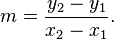
m=\frac{y_2-y_1}{x_2-x_1}.
The concept of slope applies directly to grades or gradients in geography and civil engineering. Through trigonometry, the grade m of a road is related to its angle of incline θ by the tangent function
m = \tan (\theta)\!
Thus, a 45° rising line has a slope of +1 and a 45° falling line has a slope of −1.
As a generalization of this practical description, the mathematics of differential calculus defines the slope of a curve at a point as the slope of the tangent line at that point. When the curve given by a series of points in a diagram or in a list of the coordinates of points, the slope may be calculated not at a point but between any two given points. When the curve is given as a continuous function, perhaps as an algebraic formula, then the differential calculus provides rules giving a formula for the slope of the curve at any point in the middle of the curve.
This generalization of the concept of slope allows very complex constructions to be planned and built that go well beyond static structures that are either horizontals or verticals, but can change in time, move in curves, and change depending on the rate of change of other factors. Thereby, the simple idea of slope becomes one of the main basis of the modern world in terms of both technology and the built environment.

Thursday, October 15, 2015

How to type Faster

I once found this really interesting article on how to type faster without looking at the keyboard but I know it takes a lot of practice to get to know the keyboard. Me personally,I can type really fast but I can never get the idea of typing without looking at the keyboard. Even as I am typing these words now I can type pretty fast.Now on how to type faster all you have to do is to put your hands on starting on a using all your fingers.You do not have to make all your fingers cover up the whole middle row. It's all about memorizing the key board.

HIV and AIDs

HUMAN IMMUNODEFICIENCY VIRUS (HIV)

HIV stands for human immunodeficiency virus. If left untreated, HIV can lead to the disease AIDS (acquired immunodeficiency syndrome).
Unlike some other viruses, the human body cannot get rid of HIV. That means that once you have HIV, you have it for life. No safe and effective cure for HIV currently exists, but scientists are working hard to find one, and remain hopeful.
HIV affects specific cells of the immune system, called CD 4 cells, or T cells. Over time, if left untreated, HIV can destroy so many of these cells that the body can’t fight off infections and disease. However, with proper medical care, HIV can be controlled. Treatment for HIV is called antiviral therapy or ART. It involves taking a combination of HIV medicines (called an HIV regimen) every day. Today, a person who diagnosed with HIV before the disease is far advanced and who gets and stays on ART can live a nearly normal life span.
The only way to know for sure if you have HIV is to get tested. Testing is relatively simple. You can ask your health care provider for an HIV test. Many medical clinics, substance abuse programs, community health centers, and hospitals offer them, too. You can also get an FDA-approved home HIV testing kit (the Home Access HIV-1 Test System or the OraQuick In-Home HIV Test) from a drugstore.
To find an HIV testing location near you, use the HIV Testing & Care Services Locator.

ACQUIRED IMMUNODEFICIENCY SYNDROME (AIDS)

AIDS stands for acquired immunodeficiency syndrome. AIDS is the final stage of HIV infection, and not everyone who has HIV advances to this stage.
AIDS is the stage of infection that occurs when your immune system is badly damaged and you become vulnerable to opportunistic infections. When the number of your CD4 cells falls below 200 cells per cubic millimeter of blood (200 cells/mm3), you are considered to have progressed to AIDS. (Normal CD4 counts are between 500 and 1,600 cells/mm3.) You can also be diagnosed with AIDS if you develop one or more opportunistic infections, regardless of your CD4 count.
Without treatment, people who are diagnosed with AIDS typically survive about 3 years. Once someone has a dangerous opportunistic illness, life expectancy without treatment falls to about 1 year. People with AIDS need medical treatment to prevent death.

WHERE DID HIV COME FROM?

Scientists identified a type of chimpanzee in West Africa as the source of HIV infection in humans. They believe that the chimpanzee version of the immunodeficiency virus (called simian immunodeficiency virus, or SIV) most likely was transmitted to humans and mutated into HIV when humans hunted these chimpanzees for meat and came into contact with their infected blood. Studies show that HIV may have jumped from apes to humans as far back as the late 1800s. Over decades, the virus slowly spread across Africa and later into other parts of the world. We know that the virus has existed in the United States since at least the mid- to late 1970s.

Monday, September 28, 2015

Tuesday, September 22, 2015

Ways to improve your writing

Ways to improve your writing can be very useful for example like not repeating what other people say but add your own opinions to your writing can make your reader more interested in what you say but be careful not to put too much of your own opinions because then that way, people will eventually get tired of reading what you write because of constant babbling. Make your essays as short as possible, but be sure not to make it too boring, for example, add some jokes to make your writing more preferable for other people so they can look forward to much more of what you write. When you are writing make sure to cover all your details so that your reader can be checking for your musts and enjoy your writing at the same time.

Monday, September 21, 2015

Notice

HELP WANTED
             I need people who are excellent at cartooning. Excellent at drawing. People who will not mind doing a little extra during free time. Only one position will be available.
Thank You!

Math - How to solve Radical Expressions

Even though radicals are for high school people and whatnot, I find that learning about radicals can help you alot. Radicals aren't hard tough the concept can be very confusing. Radicals are very similar to exponents because problems like, the square root of 36 is equivalent to 6 because 6 twice is 36. All those numbers that can be times itself, not to be confused by the doubling by adding, it is doubling by multiplying, are called perfect squares. The square root symbol is similarly to the long division symbol except that at the end there is a hook which is what makes the square root symbol different from the division symbol.

Search This Blog